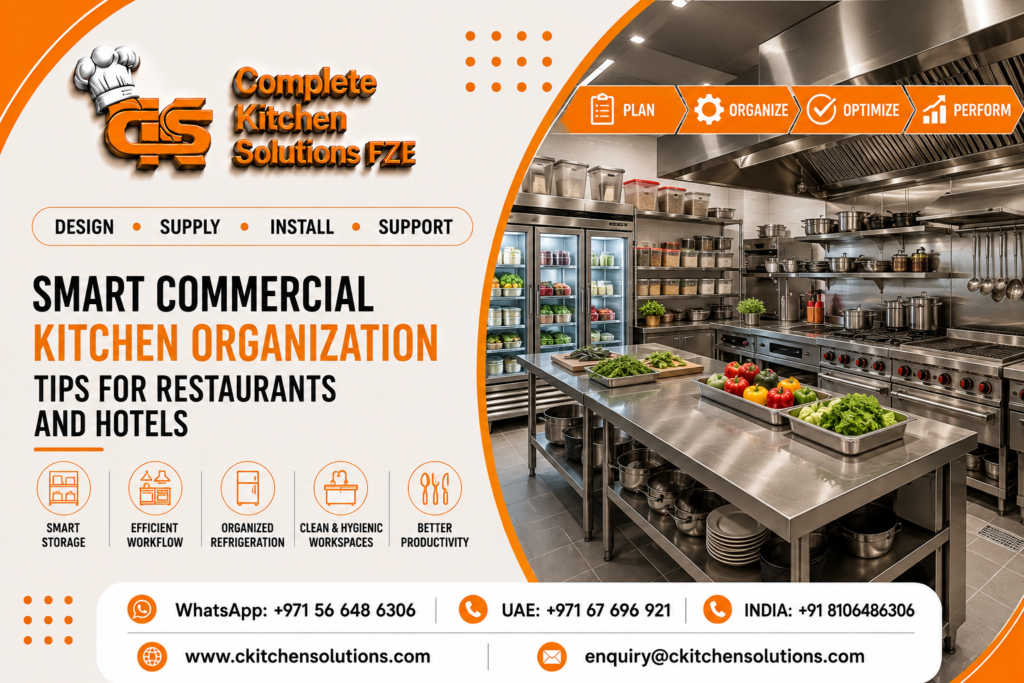
A well-organized commercial kitchen is essential for restaurants and hotels that need to deliver consistent food service throughout the day. Professional kitchens are fast-moving environments where chefs, kitchen assistants, servers, ingredients, utensils, and equipment must work together efficiently. When the workspace is poorly organized, employees may spend unnecessary time searching for ingredients, moving between stations, or working around cluttered preparation areas.
Effective commercial kitchen organization is not simply about keeping equipment and ingredients neat. It involves creating a logical workflow, using available space efficiently, positioning equipment correctly, organizing storage, maintaining hygiene, and ensuring every kitchen section has a clear purpose. Good organization can support faster preparation, better communication between employees, and more productive daily operations.
Complete Kitchen Solution FZE provides commercial kitchen equipment and professional kitchen solutions for restaurants, hotels, cafés, bakeries, catering businesses, and other food-service establishments. By considering layout, equipment requirements, available space, storage, workflow, and production capacity, we help businesses create organized kitchens designed around their everyday operational needs.
Restaurants and hotels may prepare hundreds of meals during a single service period. Employees need quick access to ingredients, utensils, cookware, refrigeration, preparation areas, and cooking equipment. If these elements are poorly positioned or disorganized, even simple tasks can take longer than necessary.
A well-planned commercial kitchen layout allows food to move logically from receiving and storage through preparation, cooking, plating, service, and washing. Each stage should connect naturally with the next without creating unnecessary movement or congestion.
Organization can also improve the overall working environment. When employees know where ingredients, utensils, and equipment belong, they can concentrate more effectively on food preparation and service.
One of the most effective ways to organize a professional kitchen is to divide it into clearly defined work zones. Different areas can be dedicated to storage, food preparation, cooking, plating, washing, and waste handling.
Creating dedicated zones helps prevent unrelated activities from interfering with each other. For example, employees carrying used cookware to the washing area should not need to move directly through a busy plating station.
The exact arrangement depends on the size and type of operation. A hotel with banquet facilities may require more specialized zones than a smaller restaurant.
Complete Kitchen Solution FZE considers these operational differences when supporting customers with commercial kitchen planning. Rather than applying the same layout to every project, equipment and work areas should be planned according to actual production requirements.
A smart kitchen layout follows the natural movement of food. Ingredients usually move from receiving to storage, then to preparation, cooking, plating, and service. Used utensils and cookware eventually move toward the warewashing area.
Equipment should support this sequence wherever possible. Frequently moving backward and forward across the kitchen wastes time and can create unnecessary congestion.
Effective restaurant kitchen organization places equipment according to how staff actually use it. Refrigeration may need to be positioned close to preparation stations, while cooking equipment should connect efficiently with plating and service areas.
Complete Kitchen Solution FZE focuses on creating commercial kitchen solutions that consider the relationship between different equipment categories rather than treating every appliance as an isolated purchase.
Storage is one of the most common challenges in commercial kitchens, particularly when floor space is limited. Shelving allows businesses to use vertical areas effectively without occupying additional preparation space.
Commercial kitchen shelving can be used for dry ingredients, containers, utensils, cookware, packaged products, and other kitchen supplies. Products should be organized logically so employees can quickly identify what they need.
Frequently used products should remain accessible, while less frequently required supplies can be placed in other appropriate locations.
Complete Kitchen Solution FZE provides professional storage and stainless steel kitchen equipment solutions that can help restaurants and hotels create more organized storage and preparation areas.
Dry storage rooms can quickly become cluttered when products are continuously delivered without a clear organization system. Flour, rice, grains, spices, canned products, packaged ingredients, oils, and other supplies should have designated locations.
Professional dry storage shelving makes inventory easier to see and helps staff maintain structured storage arrangements. Organizing products by category can also make stock checking and replenishment more manageable.
Storage requirements should be considered during the initial kitchen design process. Providing insufficient storage may eventually force ingredients and supplies into areas intended for preparation or other activities.
A well-planned commercial kitchen storage system helps protect valuable working space while supporting better inventory organization.
Preparation tables are most effective when they are actually available for food preparation. Using them as permanent storage locations for containers, appliances, packaging, or ingredients can reduce valuable working space.
Providing designated shelves, cabinets, and storage racks allows employees to return equipment and supplies to appropriate locations after use.
Clear work surfaces also make cleaning more manageable. This connection between organization and commercial kitchen hygiene is particularly important in high-volume food-service environments.
Complete Kitchen Solution FZE can help businesses select preparation tables, shelving, cabinets, sinks, and other professional kitchen equipment according to their available space and operational requirements.
Not every appliance is used with the same frequency. Equipment used continuously during service should generally be easier for employees to access than machinery required only occasionally.
For example, frequently used cooking equipment should be positioned within logical cooking zones, while essential preparation equipment should remain close to the workstations where ingredients are processed.
This approach can reduce unnecessary movement and help employees complete repetitive tasks more efficiently.
When developing a commercial kitchen design, Complete Kitchen Solution FZE considers equipment usage alongside available space, workflow, utilities, ventilation, and production requirements.
Refrigerators and freezers are central to professional food-service operations. However, simply having sufficient refrigeration capacity does not guarantee an organized kitchen.
Commercial refrigeration equipment should be positioned according to workflow and organized internally so ingredients can be identified efficiently. Products should be stored according to appropriate food-safety procedures and business inventory practices.
Frequently used ingredients may benefit from refrigerated counters or under-counter units near relevant preparation stations, while bulk storage may be managed through larger refrigerators, freezers, or cold rooms.
Complete Kitchen Solution FZE provides refrigeration solutions for restaurants, hotels, catering kitchens, cafés, and other food-service businesses based on their operational requirements.
The cooking area is often one of the busiest sections of a professional kitchen. Ranges, fryers, ovens, grills, griddles, steamers, and other commercial cooking equipment should be positioned in a way that supports efficient chef movement.
Equipment used together can often be grouped logically. At the same time, sufficient working space should remain available so multiple employees can perform tasks without constantly obstructing one another.
Cooking equipment also needs appropriate ventilation and access for cleaning and maintenance.
Complete Kitchen Solution FZE considers these practical factors when helping businesses choose and position restaurant kitchen equipment and hotel cooking solutions.
Before food reaches the cooking section, substantial preparation may be required. Cutting, slicing, mixing, peeling, processing, portioning, and other activities should be organized efficiently.
Using suitable commercial food preparation equipment can reduce repetitive manual tasks and improve production speed. Vegetable preparation machines, mixers, slicers, food processors, meat processing equipment, and bakery equipment can all have dedicated locations according to the operation.
The preparation section should also have easy access to relevant refrigeration, storage, sinks, and utensils.
Organizing these elements around the tasks being performed can create a more efficient workspace than positioning equipment simply according to where it fits.
Stainless steel commercial kitchen equipment is widely used in professional kitchens for worktables, shelves, sinks, cabinets, counters, and other applications.
These units can help businesses create clearly defined workstations while providing practical storage and preparation surfaces.
Customizing dimensions according to available space can also help make better use of areas that standard equipment may not fit efficiently.
Complete Kitchen Solution FZE provides professional kitchen solutions that can include stainless steel equipment designed around the operational needs of restaurants, hotels, and other commercial food businesses.
The washing section can become a major source of congestion if dirty and clean items are not managed efficiently. Restaurants and hotels may generate large volumes of plates, glasses, cutlery, pots, pans, trays, and utensils throughout the day.
Professional commercial dishwashing equipment can help businesses process these items more efficiently. Depending on the operation, this may include under-counter dishwashers, hood-type machines, glass washers, conveyor systems, or pot washing equipment.
The area should support a logical movement from used items through washing to clean storage. Clear separation between incoming dirty items and cleaned equipment can contribute to better organization.
Simple organizational systems can have a significant impact in busy kitchens. Clearly identifying storage locations can help employees return products and equipment to the correct place.
Dry ingredients, utensils, cookware, cleaning supplies, packaging materials, and other categories can each have designated locations.
This is particularly useful in hotels and large restaurants where many employees may use the same kitchen areas. A consistent storage system helps new and existing employees understand where items belong.
Labels should remain clear and practical rather than creating unnecessary complexity. The objective is to make daily kitchen operations easier.
Hotels often operate more complex food-service environments than individual restaurants. A property may include a main restaurant, café, banquet kitchen, pastry section, room-service kitchen, buffet area, and event catering facilities.
Effective hotel kitchen organization requires careful coordination between these different sections. Shared storage, refrigeration, food preparation, and warewashing areas should be planned according to expected demand.
Banquet kitchens may require equipment capable of supporting high-volume production, while café or pastry areas may have more specialized requirements.
Complete Kitchen Solution FZE provides hotel kitchen equipment and planning solutions that consider these different operational requirements.
Small utensils can create significant inefficiencies when poorly organized. Knives, ladles, tongs, spatulas, measuring tools, containers, and other everyday items should have designated storage locations close to where they are used.
Employees should not need to repeatedly cross the kitchen to retrieve basic tools.
At the same time, workstations should not become overcrowded. The goal is to balance accessibility with clear working space.
Small improvements in utensil organization can save considerable time across hundreds of repetitive tasks during a busy service period.
An organized kitchen should also be easy to clean. Equipment and storage systems should not create inaccessible areas where dirt and food debris can accumulate unnoticed.
Regular cleaning schedules should cover preparation surfaces, cooking equipment, refrigeration, shelving, floors, warewashing areas, and frequently touched surfaces.
Employees should understand their responsibilities for maintaining both cleanliness and organization.
Complete Kitchen Solution FZE considers hygiene and accessibility when supporting businesses with professional kitchen solutions, because equipment that is difficult to access can also become more difficult to maintain.
Waste handling should have a clear place within the kitchen workflow. Food preparation can generate packaging, trimmings, containers, and other waste throughout the day.
Waste collection points should be positioned conveniently without unnecessarily interfering with clean preparation and cooking areas.
In larger kitchens, planning how waste leaves the facility is also important. Staff should be able to move waste without disrupting active food-service areas.
Incorporating waste management into the initial commercial kitchen layout can create a more organized working environment.
Adding more equipment does not automatically make a kitchen more productive. Unnecessary appliances can consume valuable floor or counter space and make employee movement more difficult.
Every piece of commercial kitchen equipment should have a clear operational purpose. Businesses should consider production volumes, menu requirements, frequency of use, and available space before purchasing new equipment.
Complete Kitchen Solution FZE helps businesses identify solutions based on actual operational requirements. This approach can help create efficient kitchens without filling valuable space with equipment that provides limited practical benefit.
A kitchen that appears well organized during quiet periods may become congested during peak service. Organization should therefore be evaluated based on the busiest expected operating conditions.
Restaurants should consider lunch and dinner rushes, while hotels may need to account for breakfast service, banquets, conferences, weddings, and other events.
Staff movement, equipment capacity, preparation space, storage access, and plating areas should all be capable of supporting these periods.
Effective commercial kitchen planning considers peak production requirements rather than only average daily activity.
Kitchen organization should evolve with the business. Menu changes, increased customer volumes, new equipment, additional staff, and changing service models can all affect workflow.
Businesses should periodically review whether equipment remains in the most efficient location and whether storage capacity still meets operational requirements.
Employees can also provide useful feedback because they work with the kitchen layout every day. Small changes in equipment placement or storage organization can sometimes produce meaningful improvements.
A flexible approach helps businesses maintain an efficient kitchen as their operation develops.
Creating an organized professional kitchen requires more than simply purchasing appliances. Cooking equipment, refrigeration, preparation stations, storage, warewashing, stainless steel equipment, and food-service solutions need to work together within a practical layout.
Complete Kitchen Solution FZE provides commercial kitchen equipment and solutions for restaurants, hotels, cafés, bakeries, catering operations, and other professional food-service businesses.
As a commercial kitchen equipment supplier, we consider production requirements, menu type, available space, equipment capacity, storage, hygiene, and workflow when helping customers select solutions.
Our range of requirements can cover cooking, refrigeration, food preparation, bakery equipment, beverage equipment, stainless steel solutions, warewashing, storage, and other areas of professional food service.
Rather than looking at individual appliances alone, Complete Kitchen Solution FZE focuses on creating comprehensive commercial kitchen solutions that support efficient everyday operations.
A smart kitchen is not necessarily the largest kitchen or the one with the greatest number of appliances. It is a kitchen where equipment, employees, ingredients, and processes are arranged logically.
Good professional kitchen organization helps employees understand where items belong and how work should move through the facility. Appropriate storage keeps preparation areas clearer, while logical equipment placement reduces unnecessary movement.
For restaurants and hotels, these improvements can support faster preparation, better space utilization, improved cleanliness, and smoother service during demanding periods.
Complete Kitchen Solution FZE helps businesses approach kitchen organization from a complete operational perspective, combining equipment selection with practical workflow and space planning.
Effective commercial kitchen organization can make a significant difference to the everyday performance of restaurants and hotels. Clearly defined work zones, logical equipment placement, organized dry storage, efficient refrigeration, accessible utensils, professional warewashing, and clutter-free preparation areas all contribute to a more productive working environment.
Good organization should also support commercial kitchen hygiene, inventory management, staff movement, and efficient use of available space. Most importantly, kitchen organization should be planned around the actual way food moves from receiving and storage through preparation, cooking, service, and cleaning.
Complete Kitchen Solution FZE provides commercial kitchen equipment, restaurant kitchen equipment, hotel kitchen equipment, and comprehensive commercial kitchen solutions for professional food-service businesses. By considering workflow, equipment capacity, storage, hygiene, available space, and future requirements, we help businesses develop organized kitchens designed for efficient everyday operations.
