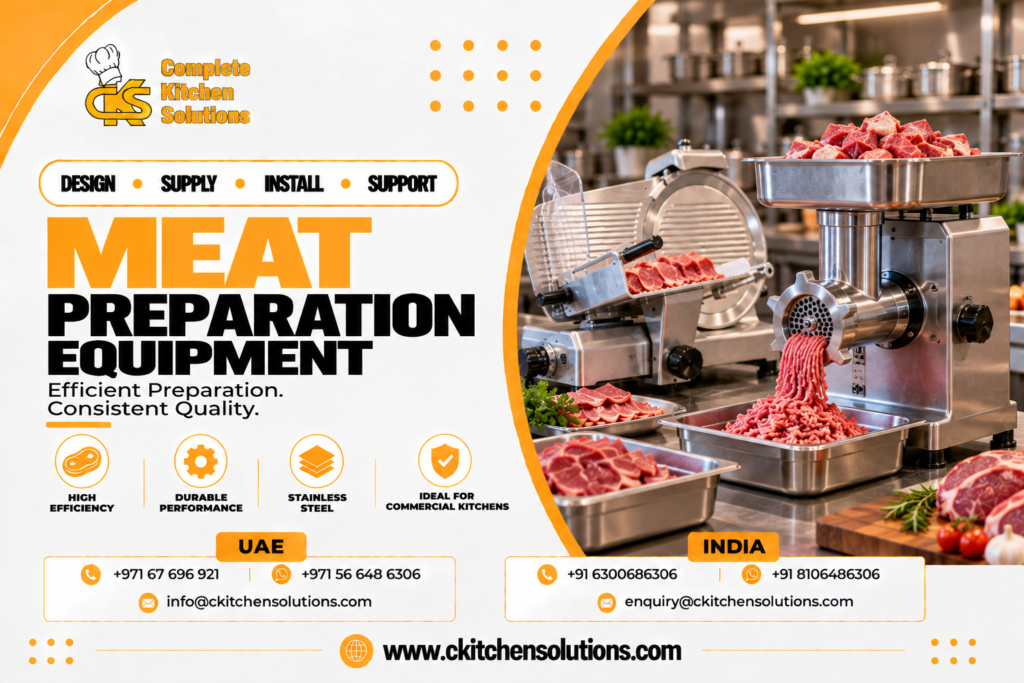
Meat preparation is an important stage in commercial food production, particularly for restaurants, hotels, catering businesses, butcher shops, central kitchens, and other food-service operations. From cutting and slicing to mincing, tenderizing, portioning, and preparing meat for cooking, these tasks require equipment that can support demanding workloads while maintaining consistency and an organized workflow. The right meat preparation equipment can help professional kitchens improve productivity, reduce repetitive manual work, and maintain consistent preparation standards.
As food-service businesses handle different types and volumes of meat every day, equipment requirements can vary considerably. A small restaurant may need compact preparation equipment, while a hotel, catering operation, or central kitchen may require higher-capacity machines for continuous production. Complete Kitchen Solution FZE helps businesses identify and integrate suitable commercial kitchen equipment according to their menu, production volume, kitchen layout, and operational requirements.
Meat preparation involves several processes before ingredients reach the cooking station. Depending on the operation, these may include portioning, slicing, mincing, tenderizing, trimming, and other preparation tasks. When these activities are performed entirely by hand, they can consume considerable time, particularly when the kitchen handles large quantities.
Professional equipment can make these repetitive processes more efficient. A commercial meat slicer, for example, can provide consistent slices for sandwiches, cold cuts, buffets, and plated dishes. Meat grinders can help process ingredients for burgers, sausages, fillings, and other preparations, while specialized equipment can support additional preparation requirements.
The objective is not simply to automate every task. Instead, equipment should be selected according to the actual workflow of the kitchen so that each machine contributes to productivity and consistency.
Busy commercial kitchens operate under strict time requirements. During preparation and service periods, staff need to process ingredients efficiently while maintaining quality. Suitable meat preparation equipment can reduce the amount of repetitive manual work involved in handling large quantities.
For restaurants and hotels, this can be particularly valuable when preparing ingredients for multiple menu items. Catering businesses may also benefit from equipment that can handle larger batches within scheduled preparation windows. Central kitchens, which produce food for multiple outlets, often require structured preparation systems where speed and repeatability are essential.
Complete Kitchen Solution FZE considers these operational requirements when developing commercial kitchen solutions. Instead of treating meat preparation equipment as an isolated purchase, the company can consider how it fits into the wider preparation, cooking, storage, and service workflow.
Consistency is an important factor in professional food production. The size and thickness of meat portions can influence cooking time, presentation, and overall product quality. When preparation is performed manually, variations may occur between individual portions or batches.
Commercial equipment can help kitchens achieve more uniform preparation results. Consistent slicing can be important for deli products, sandwiches, buffet presentations, and plated dishes. Consistent grinding can help businesses maintain standardized recipes for products such as burgers and meat-based fillings.
This level of repeatability can also simplify kitchen operations. When staff have defined preparation procedures and suitable equipment, it becomes easier to maintain standardized production across different shifts.
Meat preparation equipment is used across many types of food-service businesses. Restaurants may use meat slicers and grinders for daily menu preparation, while hotels can require equipment for restaurants, banquet operations, buffets, and large-scale food production.
Catering companies often prepare meat in substantial quantities before events, making efficient preparation particularly important. Central kitchens and institutional food-service operations may have even higher production requirements, where equipment needs to integrate into a structured food-processing workflow.
Complete Kitchen Solution FZE supports different commercial kitchen requirements by helping businesses identify equipment appropriate for their intended applications. The company can assist with equipment supply and broader kitchen planning so that meat preparation areas are practical, accessible, and integrated with other kitchen stations.
Hygiene is a fundamental consideration when handling meat in a commercial kitchen. Preparation areas need to be planned carefully to support appropriate cleaning procedures and organized food handling. Equipment should be maintained according to manufacturer recommendations, and food-contact components should be cleaned properly after use.
Kitchen layout also plays an important role. Meat preparation should have an appropriate relationship with washing, storage, refrigeration, cooking, and other work areas. A well-planned layout can help reduce unnecessary movement and support a more organized flow of ingredients and staff.
Complete Kitchen Solution FZE approaches commercial kitchen planning with these practical requirements in mind. By considering equipment placement, work surfaces, storage, and movement between preparation stages, the company helps businesses create kitchens designed around their actual operational needs.
There is no universal equipment package for every commercial kitchen. The right selection depends on several factors, including the type of meat being prepared, daily production volume, menu requirements, available space, staff workflow, and expected operating frequency.
Businesses should consider equipment capacity, construction, controls, cleaning requirements, maintenance needs, power requirements, and available accessories. The machine should also be appropriately sized for the operation. Choosing equipment that is too small may create bottlenecks, while unnecessarily large equipment can occupy valuable workspace and increase costs.
A professional kitchen planning approach can help businesses balance these considerations. Complete Kitchen Solution FZE can evaluate the broader kitchen environment and help coordinate suitable equipment with other areas such as refrigeration, preparation counters, cooking equipment, storage, and service stations.
Meat slicers are widely used in professional kitchens where uniform slices are required. They can be useful for preparing cold cuts, cooked meats, sandwich fillings, buffet items, and other menu components. Depending on the operation, businesses may also require meat grinders, tenderizing equipment, preparation tables, or other specialized equipment.
The selection should always reflect the kitchen’s actual production needs. A café with a limited meat menu may require only a compact preparation solution, whereas a hotel, catering business, or central kitchen may need several pieces of equipment to support high-volume production.
The most effective approach is to consider how each piece of equipment will interact with the rest of the kitchen. This can help create a smoother transition from receiving and storage through preparation and cooking.
Complete Kitchen Solution FZE provides more than individual pieces of commercial kitchen equipment. The company supports businesses with commercial kitchen solutions covering areas such as kitchen planning, equipment supply, installation, and project coordination.
For restaurants, hotels, catering businesses, central kitchens, and other food-service operations, this integrated approach can simplify the process of developing a professional kitchen. Equipment can be selected based on the menu, production requirements, available space, workflow, and future operational needs.
The company supports projects across markets including the UAE, India, Maldives, and Seychelles. Its approach focuses on helping businesses create practical professional kitchens where equipment, preparation areas, storage, cooking stations, and service areas work together effectively.
Meat preparation equipment plays an important role in improving the efficiency and consistency of professional food-service operations. From slicing and grinding to portioning and other preparation tasks, suitable equipment can reduce repetitive manual work and help kitchens manage demanding production schedules.
However, choosing equipment should be part of a complete kitchen planning process. Capacity, application, hygiene, maintenance, available space, workflow, and future requirements all need to be considered before making an investment. When equipment is properly matched to the operation, it can contribute to better preparation consistency and a more organized working environment.
Complete Kitchen Solution FZE helps businesses approach commercial kitchen development as a complete project, combining design, equipment supply, installation, and support. With the right meat preparation equipment integrated into a well-planned kitchen, restaurants, hotels, catering businesses, and central kitchens can create a more efficient foundation for professional food production.
