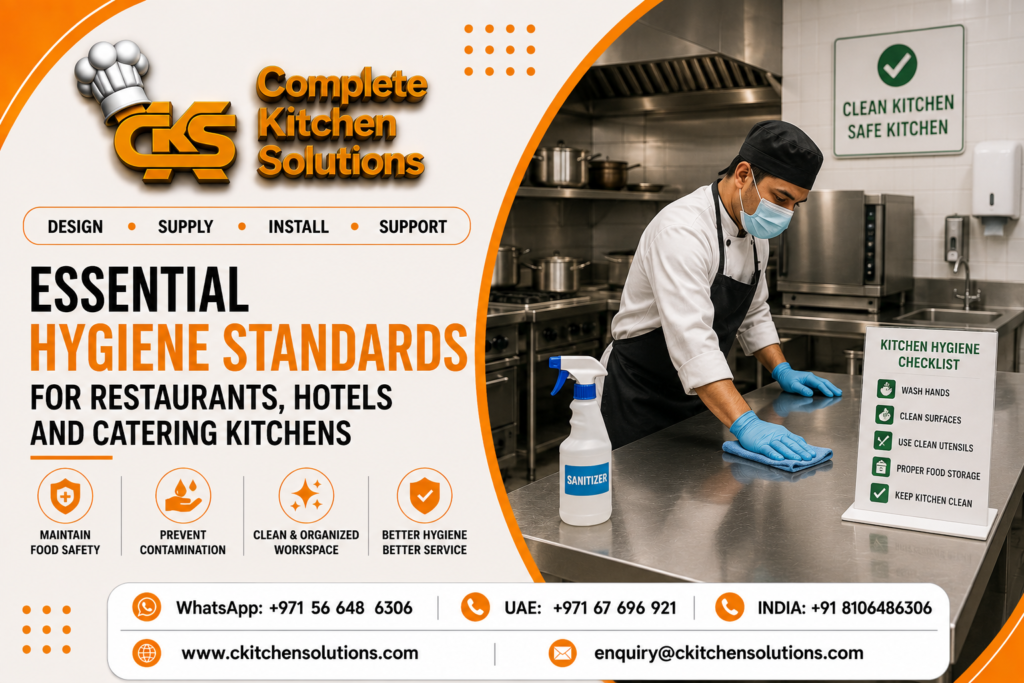
Hygiene is one of the most important foundations of any successful food-service operation. Restaurants, hotels, catering facilities, cafés, bakeries, and institutional kitchens handle large quantities of ingredients every day, making cleanliness and organized food handling essential throughout the entire operation. Maintaining strong commercial kitchen hygiene standards helps protect food quality, supports efficient workflows, reduces contamination risks, and creates a professional working environment for kitchen teams.
A hygienic kitchen depends on more than regular cleaning. Equipment selection, kitchen layout, food storage, waste management, employee practices, ventilation, refrigeration, warewashing, and preventive maintenance all contribute to overall food safety and hygiene. When these elements are planned properly, businesses can create kitchens that are easier to clean, maintain, and operate.
Complete Kitchen Solution FZE supports restaurants, hotels, catering companies, bakeries, cafés, and other hospitality businesses with professional commercial kitchen equipment and kitchen solutions. By considering hygiene alongside functionality, capacity, workflow, and equipment placement, we help businesses develop professional kitchens suited to demanding food-service environments.
Professional kitchens are busy environments where raw ingredients, cooked foods, utensils, equipment, employees, and waste can move through the same facility within a short period. Without appropriate hygiene practices, this constant activity can increase the possibility of contamination.
Strong restaurant kitchen hygiene procedures help create a controlled environment where ingredients can move logically from receiving and storage through preparation, cooking, service, and cleaning. Maintaining clean surfaces and properly organized work areas can also make kitchen operations more efficient.
For hotels and catering businesses, hygiene becomes even more important because kitchens may prepare hundreds or thousands of meals across multiple service periods. Establishing clear hygiene procedures helps employees maintain consistent practices regardless of production volume.
Hygiene begins before the first meal is prepared. The way a kitchen is designed can influence how easily it can be cleaned and how effectively staff can separate different food preparation activities.
Effective commercial kitchen design should provide logical zones for receiving, storage, preparation, cooking, plating, washing, and waste management. Staff should be able to move ingredients through these areas without unnecessary crossover between clean and potentially contaminated activities.
Complete Kitchen Solution FZE approaches commercial kitchen planning with workflow and functionality in mind. Carefully positioned cooking equipment, preparation tables, refrigeration units, sinks, storage systems, and warewashing equipment can contribute to a more organized and hygienic working environment.
Worktables, preparation counters, cutting surfaces, sinks, and other frequently used areas should be cleaned regularly. Because these surfaces can come into direct contact with food, maintaining cleanliness throughout the working day is essential.
Stainless steel kitchen equipment is widely used in professional kitchens because it provides a durable, practical surface that can be incorporated into demanding food preparation environments. Stainless steel tables, sinks, shelving, cabinets, and counters also contribute to an organized professional appearance.
Complete Kitchen Solution FZE provides stainless steel solutions and other professional kitchen equipment designed for commercial applications. Choosing appropriate equipment can make daily cleaning routines more manageable while supporting efficient preparation workflows.
Cross-contamination is a major concern in any professional food preparation environment. Raw meat, seafood, vegetables, cooked products, utensils, and ready-to-serve foods should be handled according to appropriate food-safety procedures.
Kitchen layouts can support separation by providing designated workstations for different activities. Separate utensils, cutting boards, preparation areas, and storage arrangements can also help reduce unnecessary contact between different food categories.
Employee training is equally important. Staff should understand correct food-handling procedures, hand hygiene, cleaning routines, and how to use designated equipment appropriately.
A combination of effective commercial kitchen hygiene practices, staff training, and thoughtful kitchen design provides a stronger foundation for managing contamination risks.
Employees are constantly handling ingredients, equipment, utensils, packaging, and food-service items. Proper hand hygiene should therefore be part of the everyday operating culture of restaurants, hotels, and catering kitchens.
Handwashing facilities should be conveniently located and accessible without interfering with production activities. Staff should follow the applicable food-safety requirements for when and how hands must be washed.
Good hygiene standards should be reinforced through training and supervision. Even a well-designed kitchen equipped with high-quality commercial foodservice equipment depends on employees following appropriate hygiene procedures.
Proper refrigeration plays a central role in professional kitchen hygiene and food management. Restaurants and hotels commonly store meat, seafood, dairy products, vegetables, sauces, desserts, beverages, and prepared ingredients that require controlled storage conditions.
Reliable commercial refrigeration equipment helps businesses maintain appropriate storage environments for relevant ingredients. Refrigerators, freezers, cold rooms, refrigerated counters, and under-counter refrigeration can be selected according to operational requirements.
Storage organization is also important. Products should be arranged according to appropriate food-safety procedures, and kitchen teams should regularly check stored items and equipment performance.
Complete Kitchen Solution FZE provides commercial kitchen solutions that include refrigeration options for different hospitality and food-service applications.
Commercial ranges, ovens, grills, fryers, griddles, steamers, and other commercial cooking equipment can accumulate grease, food particles, and residues during regular operation. Establishing cleaning routines helps keep equipment ready for continued professional use.
Kitchen teams should follow equipment manufacturers’ instructions regarding cleaning methods and maintenance. Some components may require daily attention, while others may be included in periodic deep-cleaning or preventive maintenance schedules.
Equipment placement also matters. Leaving appropriate access for cleaning and servicing can make maintenance more practical. Complete Kitchen Solution FZE considers these operational factors when supporting customers with equipment selection and kitchen planning.
Restaurants and hotels generate substantial quantities of plates, glasses, cutlery, cookware, trays, utensils, and food preparation tools. An efficient warewashing section is therefore a key component of professional kitchen hygiene.
Depending on the operation, businesses may use glass washers, under-counter units, hood-type machines, conveyor dishwashers, pot washers, or other commercial dishwashing equipment.
The washing area should ideally support a logical movement from used items through cleaning to clean storage. Separating dirty and clean workflows helps maintain organization and reduces unnecessary crossover.
Complete Kitchen Solution FZE provides professional warewashing solutions as part of broader commercial kitchen equipment requirements, helping businesses create more efficient cleaning operations.
A cluttered kitchen can make both cleaning and food management more difficult. Ingredients, utensils, containers, cookware, and supplies should have clearly defined storage locations.
Shelving, cabinets, refrigerated storage, dry-storage systems, and ingredient containers can help employees maintain an orderly environment. Frequently used products should remain conveniently accessible without overcrowding preparation surfaces.
Good organization also supports stock management. Regular inventory checks can help employees identify products that should be used first and keep storage areas from becoming unnecessarily congested.
Combining organized storage with suitable commercial kitchen equipment helps create a workspace where staff can work efficiently while maintaining cleanliness.
Food preparation naturally generates packaging, trimmings, leftovers, and other waste. Without a structured waste-management process, these materials can quickly affect kitchen cleanliness and workflow.
Waste collection points should be strategically positioned so employees can dispose of materials efficiently without interfering with clean preparation areas. Containers should be managed according to appropriate hygiene practices and emptied regularly.
The kitchen layout should also allow waste to move away from food preparation and service areas through an organized process. Thoughtful commercial kitchen planning can help integrate waste handling into the overall workflow rather than treating it as an afterthought.
Ventilation is another important component of a professional kitchen environment. Cooking processes can produce heat, steam, smoke, grease, and odors, particularly in high-volume restaurant and hotel kitchens.
Appropriate commercial kitchen ventilation helps manage these conditions and contributes to a more comfortable working environment. Extraction systems and hoods also require regular cleaning and maintenance according to applicable requirements and manufacturer recommendations.
Complete Kitchen Solution FZE can help businesses consider ventilation alongside cooking equipment, kitchen layout, and other operational requirements when developing professional food-service environments.
Maintaining hygiene requires consistency. Rather than relying solely on cleaning when surfaces appear dirty, professional kitchens benefit from structured cleaning schedules.
Daily routines may include work surfaces, preparation equipment, floors, sinks, and frequently touched areas. Other equipment and spaces may require weekly, monthly, or manufacturer-recommended cleaning intervals.
Businesses can assign responsibilities to specific employees or teams and maintain cleaning records where appropriate. A structured approach helps ensure that important tasks are not forgotten during busy service periods.
Regular cleaning also allows employees to inspect equipment and identify potential maintenance issues earlier.
Damaged, poorly maintained, or malfunctioning equipment can make cleaning and daily operation more difficult. Preventive maintenance should therefore form part of a broader commercial kitchen maintenance strategy.
Refrigeration systems, dishwashers, cooking equipment, food preparation machines, ventilation systems, and other appliances should be inspected and serviced according to their requirements.
Complete Kitchen Solution FZE understands that selecting equipment is only one part of developing an efficient professional kitchen. Considering accessibility, cleaning requirements, operational suitability, and long-term maintenance from the planning stage can help businesses create more practical kitchens.
Hotel kitchen hygiene can be particularly complex because hotels often operate several food-service areas simultaneously. Main restaurants, cafés, banquet kitchens, room service, pastry sections, buffets, and event catering may all function within the same property.
Maintaining organized workflows and clearly defined preparation areas helps different kitchen sections operate effectively. Appropriate refrigeration, cooking equipment, warewashing systems, stainless steel workspaces, and storage facilities also contribute to maintaining professional standards.
For hotels, kitchen equipment should be selected according to expected meal volumes and service requirements. Complete Kitchen Solution FZE works with hospitality businesses to provide hotel kitchen equipment solutions suited to professional food-service operations.
Catering operations often prepare significant quantities of food within specific deadlines. Food may also need to be held, transported, or served at another location, making organized preparation particularly important.
Professional catering kitchen equipment should support high-volume production while allowing employees to maintain appropriate hygiene procedures. Preparation areas, cooking equipment, refrigeration, holding equipment, washing systems, and storage should all work together efficiently.
An organized catering kitchen allows employees to move through different stages of production without creating unnecessary congestion. Complete Kitchen Solution FZE can help catering businesses identify suitable equipment and kitchen solutions according to their production requirements.
Equipment selection has a direct impact on how efficiently a professional kitchen can be operated and maintained. Businesses should consider durability, cleaning requirements, capacity, functionality, placement, and suitability for their particular food-service operation.
Choosing hygienic commercial kitchen equipment should be part of a broader strategy that combines effective design, employee training, regular cleaning, proper food storage, and preventive maintenance.
Complete Kitchen Solution FZE provides solutions covering cooking, food preparation, refrigeration, stainless steel fabrication, bakery equipment, beverage equipment, warewashing, food service, and other areas of professional kitchens.
Our focus is on understanding the requirements of each operation and helping customers choose solutions that fit their available space, menu, production volume, and workflow.
Creating a professional kitchen requires more than purchasing individual appliances. Equipment needs to work together within an organized layout that supports preparation, cooking, storage, service, cleaning, and maintenance.
As a commercial kitchen equipment supplier, Complete Kitchen Solution FZE supports restaurants, hotels, cafés, bakeries, catering businesses, and other food-service establishments with equipment and kitchen solutions designed around practical operational requirements.
We consider factors such as capacity, workflow, equipment placement, hygiene, available space, and long-term usability. From restaurant kitchen equipment and hotel kitchens to catering and other professional food-service environments, our goal is to help businesses create efficient and well-organized kitchens.
Maintaining high hygiene standards requires a combination of responsible food handling, effective cleaning, employee training, suitable equipment, organized storage, reliable refrigeration, proper warewashing, ventilation, waste management, and regular maintenance.
For restaurants, hotels, and catering businesses, commercial kitchen hygiene should be integrated into everyday operations rather than treated as a separate activity. A well-planned kitchen makes good hygiene practices easier to follow while also supporting efficient food preparation and service.
Complete Kitchen Solution FZE provides commercial kitchen equipment, professional kitchen equipment, and comprehensive commercial kitchen solutions for different food-service environments. By considering hygiene, functionality, workflow, capacity, and long-term operational requirements together, businesses can develop professional kitchens that support cleaner, more organized, and more efficient food-service operations.
