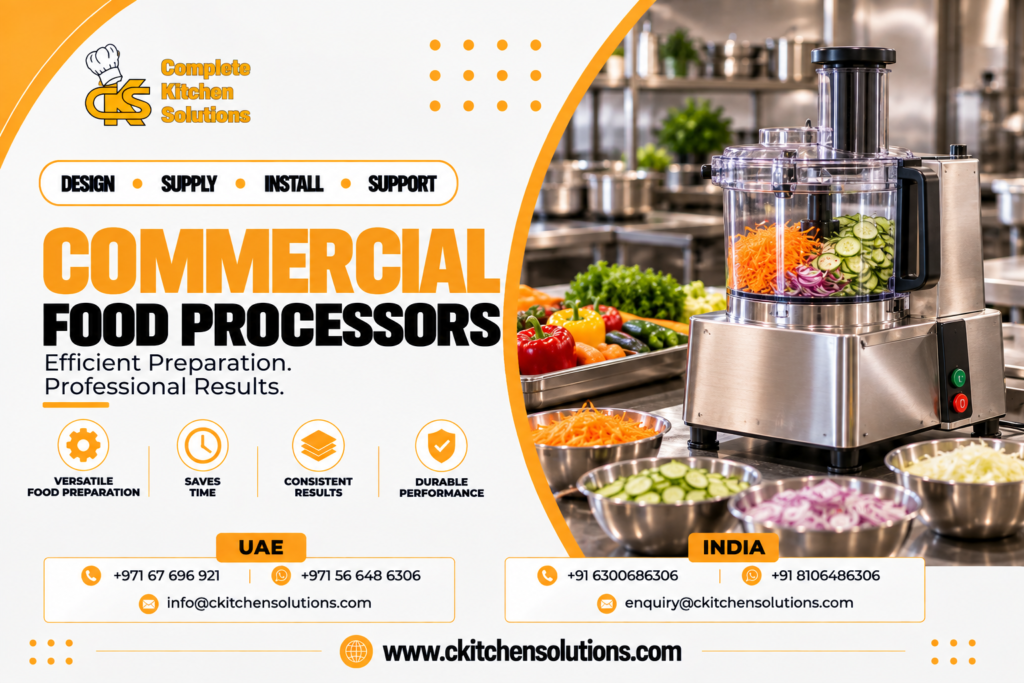
Food preparation is one of the most important stages of commercial kitchen operations. Before ingredients reach cooking equipment, service counters, or storage areas, they often need to be chopped, sliced, diced, grated, shredded, mixed, or otherwise processed. In a busy professional kitchen, performing these tasks manually can require considerable time and staff effort. This is where commercial food processors can become an important part of an efficient food preparation system.
Commercial food processors are designed to support repetitive food preparation tasks in restaurants, hotels, resorts, catering facilities, central kitchens, and other foodservice environments. By incorporating suitable processing equipment into the preparation area, businesses can organize their workflow around consistent and practical food production.
Complete Kitchen Solution FZE provides commercial kitchen equipment and integrated solutions for businesses looking to develop, upgrade, or expand professional foodservice facilities. From kitchen planning and equipment selection to supply and installation, the company helps businesses create kitchen environments based on their operational requirements.
Commercial food processors are professional food preparation machines designed to process ingredients efficiently in larger-scale foodservice operations. Depending on the equipment type and configuration, food processors can support different preparation applications such as cutting, slicing, chopping, shredding, grating, and mixing.
Unlike equipment intended primarily for domestic use, commercial processing equipment is selected for the demands of professional kitchens where food preparation may take place continuously throughout service periods. The appropriate machine depends on the type of food being prepared, required quantities, preparation methods, available space, and kitchen workflow.
For restaurants with extensive preparation requirements, hotels serving large numbers of guests, or catering businesses producing food in batches, suitable processing equipment can become an important part of the preparation section.
Time management is essential in a commercial kitchen. Ingredients may need to be prepared in large quantities before breakfast, lunch, dinner, banquet service, or catering events. Repetitive manual preparation can place additional demands on kitchen staff, particularly during busy periods.
A commercial food processor can support these repetitive tasks by providing a dedicated processing solution. This allows kitchen teams to organize preparation activities more systematically and focus their time on other important areas of food production.
The actual productivity of a processor depends on its design, capacity, attachments, ingredients, operating method, and application. Therefore, businesses should select equipment according to their specific requirements rather than simply choosing a machine based on size or processing capability.
Consistency is another important consideration for professional foodservice businesses. Ingredients often need to be prepared in similar sizes or forms to support cooking, presentation, portioning, and menu standards.
Commercial food processing equipment can help standardize repetitive preparation tasks when operated correctly. Consistent slicing, shredding, chopping, or other processing can make subsequent cooking and preparation processes more organized.
For restaurants and hotels, this can be particularly useful when the same menu items need to be prepared repeatedly. Catering and central kitchen operations can also benefit when ingredients are processed in larger batches according to established preparation procedures.
Complete Kitchen Solution FZE can help businesses consider their preparation requirements when selecting commercial food processing equipment, ensuring that the equipment forms part of a practical kitchen workflow.
Different businesses have different food preparation requirements. A restaurant may need processors for vegetables, sauces, garnishes, and other ingredients, while a hotel kitchen may require equipment capable of supporting preparation for multiple restaurants, banquets, and room-service operations.
Catering companies and central kitchens may have larger batch-processing requirements, while cafés and smaller food outlets may need compact solutions that make efficient use of limited preparation space.
This is why commercial kitchen planning is important. Equipment should be selected according to the menu, expected production volume, available workspace, staff requirements, and relationship between preparation and cooking areas.
Kitchen space is valuable, particularly in compact restaurants and foodservice facilities. Adding equipment without considering the overall layout can make movement more difficult and create unnecessary congestion.
A well-planned preparation area can position food processors close to preparation counters, ingredient storage, refrigeration, and cooking stations. This can reduce unnecessary movement and help kitchen staff follow a logical food preparation sequence.
Complete Kitchen Solution FZE approaches commercial kitchen projects as complete environments rather than a collection of individual machines. Kitchen layout, equipment selection, stainless steel fabrication, workflow, installation, and supporting systems can be considered together to create a coordinated professional kitchen.
Food processing equipment operates directly with ingredients, so cleaning and maintenance are important parts of its daily use. Equipment should be operated and cleaned according to the manufacturer’s instructions, with appropriate attention given to food-contact areas and removable components where applicable.
The surrounding preparation area should also be designed to support practical cleaning routines. Adequate workspace, organized ingredient storage, suitable sinks, and appropriate waste-handling arrangements can contribute to a more organized food preparation environment.
When planning a commercial kitchen, Complete Kitchen Solution FZE considers the relationship between preparation equipment and other kitchen sections so that businesses can establish practical workflows that support daily operations.
Choosing a food processor requires more than considering processing speed. Businesses should evaluate the type of ingredients they regularly prepare, required production volume, available space, processing applications, staff workflow, cleaning requirements, and compatibility with other kitchen equipment.
For example, a high-volume central kitchen may have different requirements from a small café. Similarly, a hotel banquet kitchen may need equipment that supports large-scale preparation, while a specialty restaurant may require equipment suited to a narrower range of ingredients.
Professional equipment selection can help businesses avoid purchasing equipment that is unsuitable for their actual operations. Complete Kitchen Solution FZE works with businesses to understand these requirements and identify appropriate commercial kitchen solutions.
Commercial food processors are only one part of a complete food preparation environment. Professional kitchens may also require cooking equipment, refrigeration, stainless steel workstations, storage, ventilation, warewashing equipment, food holding systems, and sanitation solutions.
Complete Kitchen Solution FZE provides support across these areas, including commercial kitchen design, equipment supply, stainless steel fabrication, installation, and project coordination. This integrated approach can help businesses coordinate different kitchen sections and develop an environment suited to their operational requirements.
The company supports commercial kitchen projects for restaurants, hotels, resorts, catering operations, and other foodservice businesses across markets including the UAE, India, Maldives, and Seychelles.
Commercial food processors can play an important role in modern professional kitchens by supporting repetitive food preparation tasks and helping businesses organize their production workflow. Whether ingredients need to be chopped, sliced, shredded, grated, mixed, or processed for large-scale preparation, the right equipment can become a valuable part of the food preparation section.
However, choosing a processor should always be based on the actual requirements of the business. Menu, production volume, workspace, food preparation methods, staff workflow, cleaning requirements, and equipment integration should all be considered before making a selection.
Complete Kitchen Solution FZE combines kitchen planning, equipment supply, fabrication, installation, and support to help businesses develop practical commercial foodservice environments. With appropriate planning and equipment selection, commercial kitchens can create food preparation areas that are organized around their daily operational needs and future requirements.
