Introduction
In commercial kitchens, maintaining food quality, managing preparation schedules, and storing ingredients under appropriate temperature conditions are essential for efficient operations. Hotels, restaurants, catering companies, bakeries, and food production facilities often prepare large quantities of food in advance, making effective temperature management particularly important. A blast chiller and freezer provides a specialised solution for rapidly reducing the temperature of cooked or prepared food, helping businesses manage food preparation, storage, and service more efficiently.
Unlike conventional refrigeration equipment, blast chilling and blast freezing systems are designed to cool or freeze products rapidly under controlled conditions. When used correctly alongside appropriate food-handling procedures, these systems can help businesses maintain food quality and manage prepared ingredients more effectively. At Complete Kitchen Solution FZE, we understand the importance of selecting suitable commercial refrigeration equipment for professional kitchens. We provide commercial kitchen equipment solutions that help hospitality and food-service businesses develop practical, organised, and efficient working environments.
What Is a Blast Chiller and Freezer?
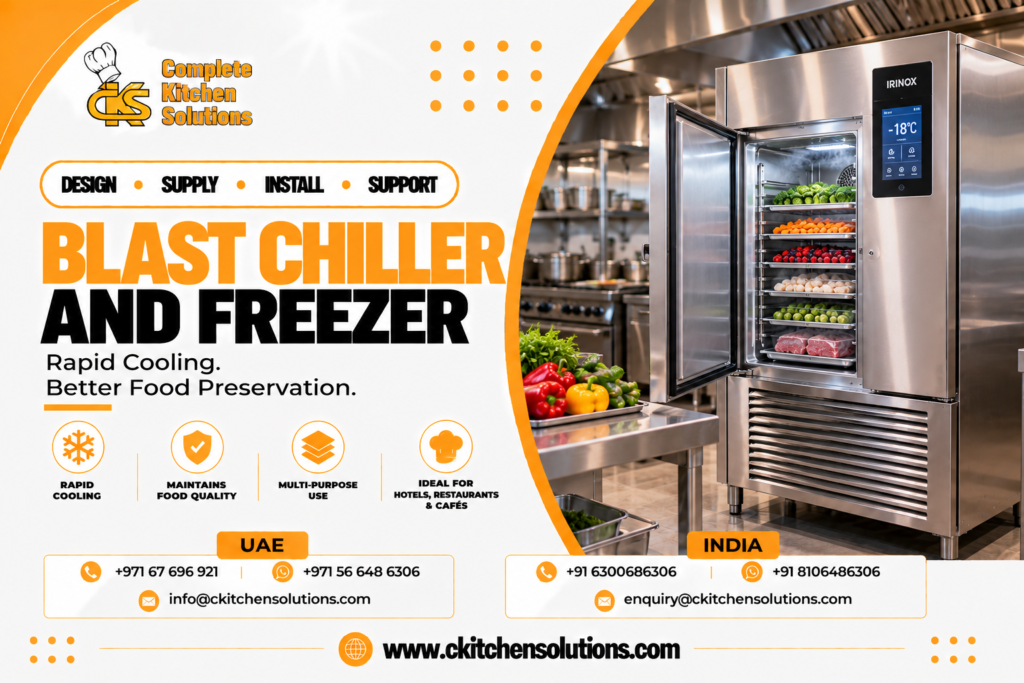
A blast chiller and freezer is commercial equipment designed to reduce food temperature rapidly using controlled cold air circulation. A blast chiller brings hot or warm food down to a refrigerated temperature within a specified period, while a blast freezer reduces the temperature further to freeze the product. Some commercial units offer both functions, allowing businesses to select the appropriate cooling cycle according to their requirements.
This equipment is particularly valuable in professional kitchens that prepare food in batches or need to organise production ahead of service. Instead of relying on conventional refrigeration to cool large quantities of hot food, kitchen teams can use a suitable blast chiller to accelerate the cooling process. The equipment’s performance depends on factors such as food quantity, product thickness, loading arrangement, starting temperature, and the selected cycle.
Commercial blast chillers and freezers are available in different capacities and configurations to accommodate various food-service operations. Smaller units may suit cafés and restaurants with moderate production requirements, while larger models may be appropriate for hotels, catering facilities, and central production kitchens. Choosing the right system requires careful consideration of daily output, available space, and operational needs.
Key Benefits of Blast Chillers and Freezers
One of the main advantages of a blast chiller is its ability to support rapid, controlled cooling. Large quantities of cooked food should not be left to cool slowly at room temperature, as this can allow harmful microorganisms to grow. Using suitable blast chilling equipment as part of a documented food-safety procedure helps businesses manage cooling more effectively. Operators must follow applicable food-safety regulations, verify the equipment’s performance, and monitor food temperatures rather than relying on the machine alone.
Another benefit is improved food preparation planning. Restaurants and hotels frequently prepare sauces, soups, cooked ingredients, and other menu components before peak service periods. Rapid cooling allows suitable foods to be moved into refrigerated storage more efficiently, helping kitchen teams organise batch production and manage preparation schedules.
Blast freezing can also support longer-term storage when food is intended to be frozen. Rapid freezing can help preserve the texture and quality of many products, although results vary depending on the ingredients, preparation methods, packaging, and storage conditions. Businesses should follow appropriate freezing, packaging, labelling, and storage procedures to maintain product quality.
Operational efficiency is another important consideration. By incorporating blast chilling into a commercial kitchen workflow, businesses can coordinate cooking, cooling, storage, and subsequent preparation more systematically. This can be especially useful for catering companies and large kitchens that prepare substantial quantities of food for different service periods.
Applications Across Different Industries
Hotels can benefit from blast chilling equipment for commercial kitchens when preparing food for restaurants, buffets, banquets, and room-service operations. Large hotel kitchens often handle varied menus and high production volumes, making effective cooling procedures important for organised food preparation. A suitable system can support batch cooking and help staff prepare selected ingredients ahead of scheduled service.
Restaurants can use blast chillers to cool soups, sauces, cooked vegetables, and other appropriate food products before refrigerated storage. This can help kitchen teams manage preparation schedules while following established food-safety procedures. The equipment should be selected according to the restaurant’s menu, batch sizes, and expected production volume.
Catering businesses may require blast chillers and freezers to prepare food for corporate events, weddings, conferences, and other large gatherings. These operations often depend on planned production schedules, so controlled cooling and freezing can help coordinate preparation and storage before food is transported or served. Businesses must also maintain suitable temperature controls during handling and transportation.
Bakeries and pastry kitchens can use suitable blast chilling or freezing equipment for selected pastry components, desserts, fillings, and other products. Depending on the application, rapid cooling or freezing can help manage production schedules and preserve product characteristics. Food manufacturers and central kitchens may also use these systems to support batch processing and organised chilled or frozen storage.
Choosing the Right Blast Chiller and Freezer
Selecting the right commercial blast chiller and freezer begins with understanding the kitchen’s production requirements. Businesses should estimate the quantity of food that needs to be chilled or frozen during each cycle. Equipment that is too small may restrict production, while an unnecessarily large unit may occupy valuable space and increase investment costs.
Cooling and freezing performance are equally important. Buyers should examine the manufacturer’s stated cycle times, rated capacity, temperature range, and testing conditions. Actual performance depends on the type of food, portion size, loading arrangement, and starting temperature. It is important to select a unit that can accommodate the products and batch sizes used in daily operations.
The available kitchen layout must also be considered. A blast chiller or freezer should be positioned where staff can load and unload food efficiently without obstructing other workstations. Adequate ventilation, drainage where required, electrical supply, and installation clearances should comply with the manufacturer’s recommendations.
Other factors include ease of cleaning, control settings, temperature monitoring, energy consumption, maintenance requirements, and technical support. Businesses should also consider whether they need separate chilling and freezing equipment or a combination unit that offers both functions.
Most importantly, staff must be trained to use the equipment correctly. Appropriate food portions, correct loading practices, temperature verification, cleaning procedures, and documented food-safety processes all contribute to effective operation.
Why Choose Complete Kitchen Solution FZE?
At Complete Kitchen Solution FZE, we understand that every commercial kitchen has different equipment requirements, production volumes, and operational priorities. A restaurant preparing food for daily service may need a different cooling capacity from a hotel kitchen, catering company, or central food production facility.
We provide commercial kitchen equipment solutions and support projects through services that can include kitchen design, equipment supply, installation, and support, depending on the project scope. When helping businesses explore blast chillers and freezers, important considerations include production capacity, cooling requirements, available space, operating procedures, and compatibility with the wider kitchen layout.
Our broader solutions support restaurants, hotels, bakeries, catering companies, and other food-service businesses. Whether a business is establishing a new kitchen or upgrading its existing refrigeration systems, Complete Kitchen Solution FZE aims to help customers identify practical equipment options suited to their operational requirements.
We serve customers across markets including the UAE and India, while also addressing commercial kitchen equipment requirements in the Maldives and Seychelles, depending on project needs and service availability. By considering each project’s specific requirements, we help businesses make informed equipment decisions that support organised food preparation and efficient kitchen operations.
Conclusion
A blast chiller and freezer is an important investment for commercial kitchens that require rapid, controlled cooling and efficient food preparation management. From hotels and restaurants to catering companies, bakeries, and central production kitchens, this equipment can support organised batch preparation, chilled storage, and freezing processes when used correctly.
Choosing the right capacity, understanding equipment performance, training staff, and following applicable food-safety procedures are essential for effective operation. Complete Kitchen Solution FZE helps businesses explore commercial refrigeration and kitchen equipment solutions suited to their needs. With appropriate equipment selection and careful workflow planning, food-service businesses can improve preparation efficiency, manage storage more effectively, and maintain consistent operational standards.